“The Hidden Harmony is better than the obvious… Nature loves to hide”
Heraclitus
Post-War Mass Housing Programme
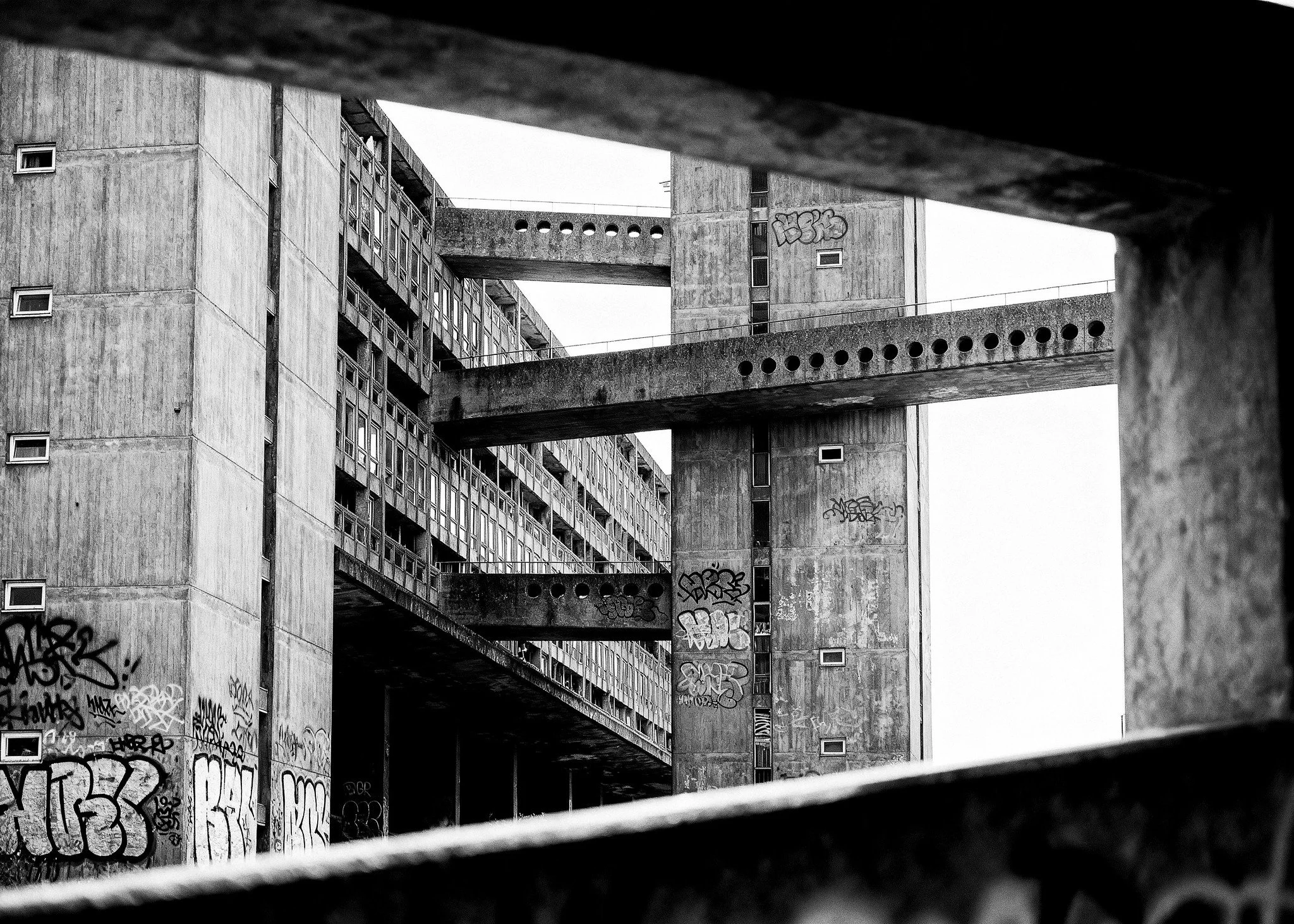
Britain’s post-war housing programme was born of urgency and conviction: a commitment to provide dignified homes at scale, guided by modernism’s belief in rational design, light, and clarity. Concrete became both material and manifesto—structural honesty, serial repetition, and monumental forms that promised efficiency and equality. These ambitions took on a severe beauty: deep slab facades, expressed circulation cores, punched openings and cantilevered walkways, all arranged with purpose to remake urban life.
Time has complicated that promise. As councils faced shrinking budgets, fragmented policy, and deferred maintenance, the architecture hardened into its own predicament: surfaces weathered, services failed, and the social contract frayed.
Post-War Mass Housing Programme
Britain’s post-war housing programme was born of urgency and conviction: a commitment to provide dignified homes at scale, guided by modernism’s belief in rational design, light, and clarity. Concrete became both material and manifesto—structural honesty, serial repetition, and monumental forms that promised efficiency and equality. These ambitions took on a severe beauty: deep slab facades, expressed circulation cores, punched openings and cantilevered walkways, all arranged with purpose to remake urban life.
Time has complicated that promise. As councils faced shrinking budgets, fragmented policy, and deferred maintenance, the architecture hardened into its own predicament: surfaces weathered, services failed, and the social contract frayed.
Post-War Mass Housing Programme
Britain’s post-war housing programme was born of urgency and conviction: a commitment to provide dignified homes at scale, guided by modernism’s belief in rational design, light, and clarity. Concrete became both material and manifesto—structural honesty, serial repetition, and monumental forms that promised efficiency and equality. These ambitions took on a severe beauty: deep slab facades, expressed circulation cores, punched openings and cantilevered walkways, all arranged with purpose to remake urban life.
Time has complicated that promise. As councils faced shrinking budgets, fragmented policy, and deferred maintenance, the architecture hardened into its own predicament: surfaces weathered, services failed, and the social contract frayed.
Post-War Housing Programme
Britain’s post-war housing programme was born of urgency and conviction: a commitment to provide dignified homes at scale, guided by modernism’s belief in rational design, light, and clarity. Concrete became both material and manifesto—structural honesty, serial repetition, and monumental forms that promised efficiency and equality. These ambitions took on a severe beauty: deep slab facades, expressed circulation cores, punched openings and cantilevered walkways, all arranged with purpose to remake urban life.
Time has complicated that promise. As councils faced shrinking budgets, fragmented policy, and deferred maintenance, the architecture hardened into its own predicament: surfaces weathered, services failed, and the social contract frayed.
Post-War Mass Housing Programme
Britain’s post-war housing programme was born of urgency and conviction: a commitment to provide dignified homes at scale, guided by modernism’s belief in rational design, light, and clarity. Concrete became both material and manifesto—structural honesty, serial repetition, and monumental forms that promised efficiency and equality. These ambitions took on a severe beauty: deep slab facades, expressed circulation cores, punched openings and cantilevered walkways, all arranged with purpose to remake urban life.
Time has complicated that promise. As councils faced shrinking budgets, fragmented policy, and deferred maintenance, the architecture hardened into its own predicament: surfaces weathered, services failed, and the social contract frayed.
Post-War Mass Housing Programme
Britain’s post-war housing programme was born of urgency and conviction: a commitment to provide dignified homes at scale, guided by modernism’s belief in rational design, light, and clarity. Concrete became both material and manifesto—structural honesty, serial repetition, and monumental forms that promised efficiency and equality. These ambitions took on a severe beauty: deep slab facades, expressed circulation cores, punched openings and cantilevered walkways, all arranged with purpose to remake urban life.
Time has complicated that promise. As councils faced shrinking budgets, fragmented policy, and deferred maintenance, the architecture hardened into its own predicament: surfaces weathered, services failed, and the social contract frayed.
Post-War Mass Housing Programme
Britain’s post-war housing programme was born of urgency and conviction: a commitment to provide dignified homes at scale, guided by modernism’s belief in rational design, light, and clarity. Concrete became both material and manifesto—structural honesty, serial repetition, and monumental forms that promised efficiency and equality. These ambitions took on a severe beauty: deep slab facades, expressed circulation cores, punched openings and cantilevered walkways, all arranged with purpose to remake urban life.
Time has complicated that promise. As councils faced shrinking budgets, fragmented policy, and deferred maintenance, the architecture hardened into its own predicament: surfaces weathered, services failed, and the social contract frayed.